Disclosure: HarvestMap is reader-supported. If you buy through links on this page, we may earn a commission at no extra cost to you.
Start with your weekly wet volume. Once your weekly wet volume, batch frequency, or shift pattern outgrows what a home machine can absorb, you need to step up to a freeze dryer industrial unit. A Harvest Right commercial unit handles 65 to 100 lbs per batch (Harvest Right). When you need more than that ceiling on a repeating schedule, buying a second home unit adds labor and floor space without giving you a real production rhythm. Compare commercial and industrial classes of freeze dryer industrial equipment by batch capacity, shelf area, and utilities, then match the tier to your throughput instead of your ambitions.
Industrial Freeze Dryers: The Direct Answer on When Home Units Stop Being Enough
An industrial freeze dryer is the right answer once your weekly wet volume, batch frequency, or shift pattern outgrows what a home machine can absorb. A Harvest Right commercial unit handles 65 to 100 lbs per batch (Harvest Right). When you need more than that ceiling on a repeating schedule, buying a second home unit adds labor and floor space without giving you a real production rhythm.
Industrial is a measurable tier, not a marketing word. The commercial range runs 2.5 to 10 m² of shelf area and 25 to 100 kg per batch. Industrial expands that to 5 to 500 m² and 50 to 1000 kg (Dumai).
The chamber isn’t the only change. Industrial systems keep the same 10 Pa ultimate vacuum, scroll compressor, double-stage vacuum pump, and -40°C cold trap as commercial units (Dumai). Process quality holds steady. Throughput is what moves.
What separates a cheap machine from a real one
The cheap tier isn’t freeze drying at all. Anything at a couple hundred dollars is a dehydrator with better branding.
How to decide
Work out your wet pounds per week, not per batch. If a single commercial batch covers a week of orders, stay where you are. If you are running the machine daily and turning product away, price the next tier up. Don’t buy a third home unit as a workaround.
Options and Methods: What Industrial Freeze Drying Actually Looks Like
The market splits into three tiers. Wet pounds per batch sets the tier you buy from, not the brand.
Home units sit at the bottom. Harvest Right’s commercial model freeze dries 65-100 lbs per batch depending on your product (F130). Mid-scale commercial machines go a bit higher: the Parker Summit Series handles up to 97 pounds wet weight per batch, with 15 individually heated trays (F114, F117). Industrial models jump far past both. Parker’s industrial line reaches up to 4,000 pounds wet weight per batch (F115).
At the top, the scale stops resembling an appliance.
Configuration choices that matter at this scale
Condenser placement affects batch homogeneity. Internal versus external condensers, and whether the condenser sits at the side, bottom, or rear of the chamber, all change how evenly a batch dries (F59). On industrial units the shelf temperature range widens to -35°C to 70°C (F23), which lets you run products that a home machine can’t touch.
If you only need a small affordable unit
Anything cheaper is a dehydrator or a toy. Skip it. The common advice to “start cheap and upgrade later” wastes money twice, because a dehydrator can’t sublimate ice and will never produce freeze-dried texture. Buy the home tier or wait.
Costs and Trade-offs: The Real Numbers Behind Industrial Scale
Industrial freeze drying is a construction project, not an appliance purchase. It weighs 33,500 kg and sits on a 7.20m x 2.80m x 2.58m footprint (Cuddon Freeze Dry). Plan for plant skids on separate foundations, not a corner of the garage.
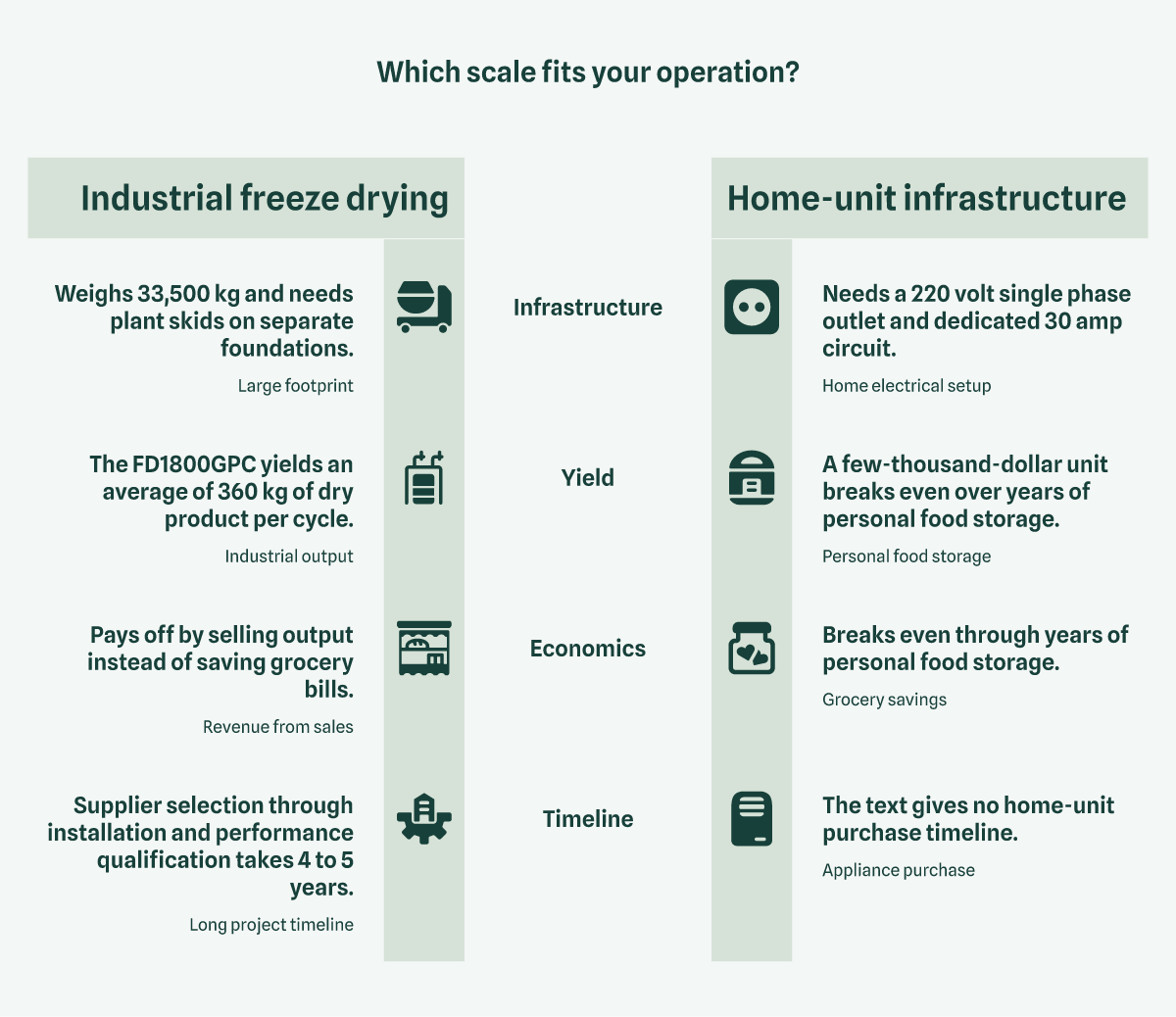
Compare that with home-unit infrastructure: a 220 volt single phase outlet and a dedicated 30 amp circuit (Harvest Right). That is the whole electrical conversation at home scale.
The yield math that decides everything
Dry output per cycle decides whether the machine pays for itself. The FD1800GPC yields an average of 360 kg of dry product per cycle, based on 1,800 kg of wet product at 80% moisture (Cuddon Freeze Dry). Run that arithmetic against your own incoming volume before you sign anything. If your weekly wet tonnage can’t keep a chamber that size loaded, you’re paying for idle steel.
At home scale, a freeze dryer that costs a few thousand dollars breaks even over years of personal food storage. Industrial scale flips that math, since you’re selling output instead of saving grocery bills. That reframe is the whole decision.
The timeline nobody budgets for
End to end, from supplier selection and design review through installation and the close of performance qualification, expect 4 to 5 years. Skip customized protocol development and you might save an estimated 6 to 9 months (AAPS PharmSciTech). Build that into your business case. If you can’t wait, buy used capacity or contract production instead.
Recommendations by Situation: Which Tier Fits Which Operator
Home producers and small candy sellers
Selling freeze-dried candy or small batches at home? A Harvest Right commercial unit at 65 to 100 lbs per batch (Harvest Right) is your entry point. It runs on a 220 volt single phase outlet with a dedicated 30 amp circuit (Harvest Right), so most garages and utility rooms can host it without an electrician rebuilding the panel.
Don’t buy a second home unit when you outgrow the first. Two machines double your labor and your floor space while leaving you with the same per-batch ceiling. Step up to a machine with real commercial capacity instead.
Mid-scale and industrial operators
Match the machine to your weekly wet volume, not your best day. Parker’s Summit Series handles up to 97 pounds wet weight per batch (Parker Freeze Dry), which suits a farm stand or a small co-packing run. Parker’s industrial models reach up to 4,000 pounds wet weight per batch (Parker Freeze Dry).
It weighs 33,500 kg (Cuddon Freeze Dry). Treat the purchase as a building project, not an equipment order.
Size for the peak, not the average, if your volume comes in seasonal waves. A machine built for your quiet months will quit on you every harvest. Plan to toll-process or dry-farm the off months instead.
Check the utility envelope before you sign anything. The FD1800GPC peaks at 214 kW and draws 110 kW in typical dry operation (Cuddon Freeze Dry). Confirm your service entrance can carry that load before you commit.
FAQ
Is freeze-drying a profitable business?
Profit comes from volume, not from owning a machine. Industrial freeze dryers are built for sustained output. Cuddon’s FD1800GPC has a 1,800kg ice capacity and a 170.5m2 shelf area, and its average yield of dry product per cycle is 360 kg based on 1,800 kg wet product at 80% moisture. That’s production scale, not a side project. Selling food also brings labeling and facility rules that vary by state and country, so check with your state agriculture department or the FDA before you count on revenue. Skip the business plan until you have a buyer and a licensed kitchen.
Why is everyone selling their freeze dryers?
Usually the machine size doesn’t match how people actually use it. That’s not a defect in the machines. Home units are built for intermittent batches, and the Harvest Right listing describes a yearly output that “would require a person to use the freeze dryer 4 times a week for 50 weeks a year.” Owners who buy for occasional use find that pace unrealistic. Industrial buyers face the same math at a larger scale. The AAPS PharmSciTech best-practices paper notes the end-to-end process “can often take 4–5 years from supplier selection, procurement, and design review to installation with the end of performance qualification.” Buy for the throughput you will actually run.
What are the downsides of using a freeze dryer?
Time, utilities and floor space top the list. A batch cycle runs long, and the AAPS PharmSciTech paper describes the end-to-end equipment process as time-consuming. Large machines draw serious power. The same unit weighs 33,500 kg, so it needs a real floor and real clearance. Smaller units skip the weight but still need a dedicated circuit, and Harvest Right specifies a dedicated 30 amp circuit for its commercial model.
Is owning a freeze dryer worth it?
A freeze dryer pays off when you have steady input and a plan for the output. Match the machine to your batch size first.
Dumai’s commercial model covers a 2.5 m2 to 10 m2 shelf area and 25 kg to 100 kg batch capacity. Its industrial model expands to 5 m2 to 500 m2 shelf area and 50 kg to 1000 kg batch capacity. Parker’s commercial range runs from 97 lbs to 4000 lbs wet weight per batch. If your harvest or production doesn’t fill the small end of that range, the machine sits idle and the answer is no.
Are Harvest Right freeze dryers still having quality issues?
No figure in the research here measures defect rates, so you can’t quote a rate. Equipment capability and performance qualification do matter, though. The AAPS PharmSciTech paper stresses “the importance of understanding equipment capability” and cites a failed scale-up lot caused by choked flow. Whatever brand you buy, ask for the shelf temperature mapping, condenser performance and leak rate data. Never accept a machine without documented performance testing, even when the spec sheet looks convincing.
Sources
- Commercial vs. Industrial Freeze Dryers: How to Compare Throughput, Batch Capacity, and Energy Efficiency
- FD1800GPC Freeze Dryer - Cuddon Freeze Dry
- Recommended Best Practices in Freeze Dryer Equipment Performance Qualification: 2022 | AAPS PharmSciTech | Springer Nature Link
- • Intellitronics™ controller with manual and automatic
- Commercial Freeze Dryers | Parker Freeze Dry
- Commercial and Industrial Freeze Drying Machines - Vikumer Freeze Dry
- Home Freeze Dryers for Food Preservation– Harvest Right
- Commercial Freeze Dryers for Food Production | Harvest Right